
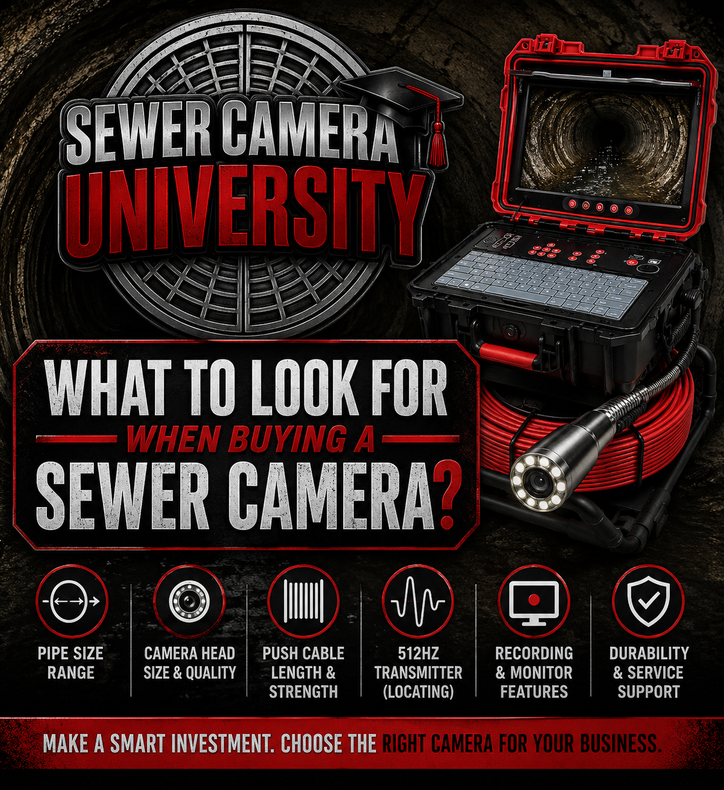
What to Look for When Buying a Sewer Camera
Buying a sewer camera is a big decision for any plumber, drain cleaner, sewer inspection company, or contractor. A good sewer camera can help you diagnose problems faster, provide proof to customers, locate underground issues, and create new revenue opportunities for your business.
But not all sewer cameras are built the same.
Some systems are designed for small residential lines. Others are built for longer runs, larger pipe, kitchen lines, lateral lines, heavy daily use, to throw away/disposal cameras . Before you spend thousands of dollars on a sewer inspection camera, it is important to understand what features actually matter.
At Sewer Camera University, our goal is to help you make a smarter buying decision before investing in your next sewer camera system.
1. Know What Size Pipe You Will Be Inspecting
The first thing to consider when buying a sewer camera is the pipe size you plan to inspect most often.
Different cameras are designed for different pipe ranges. A camera that works well in a small 1.5” or 2” line may not be the best choice for larger 4”, 6”, or 8” lines. Likewise, a larger camera head may not be able to navigate tight bends in smaller pipe. (Remember there is no one size fits all camera they all have their uses.
Common sewer camera pipe ranges include:
- 1” to 4” lines — best for small residential drains, sinks, tubs, branch lines, and tight access points.
- 2” to 6” lines — a strong all-around range for residential and light commercial sewer inspections.
- 3” to 10”+ lines — better suited for larger sewer mains, commercial lines, and municipal-style inspections.
If you are a plumbing or drain cleaning company, a camera that handles 2” to 6” lines is often one of the most useful setups because it covers many common residential sewer inspection jobs.
Before buying, ask yourself:
- What size pipe do I inspect most often?
- Do I need to get through tight bends?
- Am I mostly doing residential or commercial work?
- Do I need one camera system or multiple systems for different pipe sizes?
- What is my budget?
- What do other plumbers use?
- What is reliable?
- Where do I take it for service and is it near me?
- Did I call All Star? (We specialize in cameras and knows all brands inside and out, we won't just push you into our brand if it is not a fit)
Choosing the wrong camera size can lead to frustration, poor inspections, and missed opportunities in the field.
2. Camera Head Size Matters
The camera head is one of the most important parts of the sewer camera system.
A smaller camera head can usually move through tighter turns and smaller lines. A larger camera head may provide a stronger build, better lighting, and improved visibility in larger pipe, but it may not be ideal for tight bends.
When comparing camera heads, look at:
- Diameter of the camera head
- Image quality
- Lighting strength
- Durability
- Whether it is self-leveling
- Whether it has a built-in transmitter
- Whether it is detachable or serviceable
A good sewer camera head should be small enough to move through the pipe sizes you inspect, but strong enough to handle real jobsite use. Don't buy a thow away system if you are inspection everyday. Buy something that can be serviced quickly and reliably. Down time and being without in a successful Plumbing company will just cost you money. Have backups and a service plan for when it is down. They all go down be ready.
3. Self-Leveling Camera Head vs Non-Self-Leveling
A self-leveling camera head keeps the image upright while the camera moves through the pipe. This makes inspections easier to watch, easier to explain to customers, and easier to record.
Without self-leveling, the image may rotate as the camera travels through the line. That can make it harder to understand what you are looking at, especially during longer inspections.
Benefits of a self-leveling camera include:
- Easier viewing
- More professional inspection videos
- Better customer presentations
- Less confusion when diagnosing pipe problems.
- Cleaner recordings and documentation
Negative:
- Just one the slip ring/self leveling mechanism is a fail point and will go out at some point.
If you plan to use your sewer camera professionally, a self-leveling camera head is usually worth the investment.
4. Push Cable Length: How Much Do You Really Need?
Push cable length is another major factor when buying a sewer camera.
Common lengths include:
- 100 ft
- 120 ft
- 165 ft
- 200 ft
- 300 ft or more
For many residential jobs, a camera in the 100 ft to 165 ft range may be enough. For longer sewer laterals, commercial work, or larger properties, a 200 ft system may be a better choice. Also remember the longer push cable you can afford and carry the more room you have on the cable when kinks and damage occurs. This will give you a longer run life.
However, longer is not always better.
A longer push cable can give you more reach, but it may also make the reel larger, heavier, and more expensive. The key is choosing the length that matches your daily work.
Ask yourself:
- How far do I normally need to inspect?
- Am I inspecting short branch lines or long sewer mains?
- Do I need a lightweight system or maximum reach?
- Will my technicians be carrying this camera every day?
For most plumbing and drain cleaning businesses, a sewer camera with 165 ft to 200 ft of push cable is a strong professional range.
5. Push Rod Strength and Flexibility
The push rod is what allows you to move the camera through the pipe. It needs to be flexible enough to get through bends, but strong enough to push long distances without kinking or breaking.
A weak push rod can make inspections harder and may lead to costly repairs.
When comparing push rods, consider:
- Diameter of the push rod
- Flexibility
- Stiffness
- Durability
- Field-replaceable design
- Repair cost
- How well it pushes through long runs
Smaller push rods are better for tight turns and smaller pipe. Larger or stiffer push rods are better for longer runs and larger pipe.
This is one of the biggest reasons to match the sewer camera system to the type of work you do most often.
6. Built-In 512Hz Transmitter
A built-in 512Hz transmitter, also called a sonde, is one of the most valuable features on a professional sewer camera.
The transmitter allows you to locate the camera head underground using a compatible locator. This helps you find the exact location of a blockage, break, belly, root intrusion, or damaged pipe section. Keep in mind you will still need a line locator to locate this transmitter so keep that cost in mind when you are coming up with your camera budget.
Why this matters:
- You can mark the problem area above ground.
- You can reduce unnecessary digging.
- You can provide better information to the customer.
- You can create more accurate repair estimates.
- You can turn inspections into profitable repair opportunities.
If you are using a sewer camera for professional plumbing, drain cleaning, or sewer repair work, a built-in transmitter is a major advantage.
7. Monitor Quality and Recording Options
The monitor is where you view the inspection, but it should do more than just show video.
A good sewer camera monitor should offer:
- Clear display
- Easy controls
- USB/SD recording (WIFI recording APP if emailing videos reports **more professional**
- Photo capture
- Date and time stamp
- On-screen footage counter
- Text input if needed
- Bright screen for outdoor use
- Durable jobsite-friendly design
Recording is especially important because customers often want proof of what you found. A recorded inspection can help build trust and support repair recommendations.
If your sewer camera allows USB recording, you can save videos and provide them to customers after the inspection. Reminder wifi recording via app is becoming the new standard most company's and individuals prefer an email file to easily share the report.
That makes your service look more professional and can help close more jobs.
8. Footage Counter
A footage counter tells you how far the camera has traveled into the pipe.
This is extremely helpful when identifying where a problem is located. For example, if you see a break at 72 feet, you can combine that information with your locator to better determine where the issue is underground.
A footage counter helps with:
- Locating pipe problems
- Explaining findings to customers
- Creating repair estimates
- Reducing guesswork
- Improving inspection reports
For professional sewer inspections, a footage counter is a feature worth having.
9. Durability and Repairability
Sewer cameras are used in tough environments. They get pushed through dirty lines, around bends, through roots, through standing water, and into rough pipe conditions.
Because of that, durability matters.
But repairability matters just as much.
Before buying a sewer camera, ask:
- Can the camera head be replaced?
- Can the push rod be repaired or replaced?
- Are parts available?
- Who services the system?
- How long does repair usually take?
- Is the system built for daily use?
- Can I get support after the sale?
- Do I have a mobile sales rep that can come to me?
A cheaper camera may seem like a good deal at first, but if it cannot be repaired easily, downtime can cost you more in the long run.
A sewer camera is not just a product. It is a tool your business depends on. Make sure you buy from a company that can support you after the sale.
10. Portability and Jobsite Use
A sewer camera should be easy to transport, set up, and use in the field.
Consider:
- Overall weight
- Frame design
- Reel size
- Handle placement
- Battery power
- AC power option
- Monitor mounting
- Storage space in your truck or van
- Rugged
If your team uses the camera every day, a heavy or awkward system can slow them down.
A good sewer camera should be strong, but also practical for real jobsite use.
11. Battery Power vs AC Power
Many professional sewer cameras offer battery power, AC power, or both.
Battery power is useful when working outside, in basements, on jobsites, or in areas without easy access to an outlet. AC power is useful for longer inspections or shop testing.
Ideally, look for a system that gives you flexibility.
A good setup may include:
- Rechargeable battery
- Battery charger
- AC power cord
- Long runtime
- Easy battery replacement
Power options may not seem like a big deal until you are on a job and cannot easily plug in your equipment.
12. Customer Support and Service After the Sale
This is one of the most overlooked parts of buying a sewer camera.
A sewer camera will eventually need service. Camera heads get damaged. Push rods wear out. Monitors fail. Connectors break. Transmitters stop working.
The question is not just, “What camera should I buy?”
The better question is:
Who is going to support me after I buy it?
Before purchasing, find out:
- Does the seller offer repairs?
- Do they understand sewer cameras?
- Can they help troubleshoot problems?
- Do they stock parts?
- Do they offer fast turnaround?
- Can they help you choose the right system before you buy?
- All Star Sewer Equipment can help in all these areas!
Buying from a company that sells and services sewer cameras can save you time, money, and frustration. we aren't your local depot this is all we know and do. Take advantage!
13. Price vs Value
Price matters, but the cheapest sewer camera is not always the best deal.
A low-cost camera may work for occasional use, but professional plumbers and drain cleaners need equipment that can handle daily jobs.
When comparing price, consider:
- Image quality
- Push cable durability
- Transmitter capability
- Recording features
- Repairability
- Warranty and support
- Parts availability
- Downtime if the system fails
A better sewer camera can help you make more money by allowing you to charge for inspections, document problems, sell repair work, and provide better service to your customers.
Instead of only asking, “How much does it cost?” ask:
How much can this camera help my business earn?
14. Match the Camera to Your Business
The best sewer camera is not always the most expensive one. It is the one that fits your work, your budget, and your business goals.
For example:
- A small plumbing company may need a compact camera for residential lines.
- A drain cleaning company may need a durable system with a strong push rod and transmitter.
- A sewer repair company may need a longer cable and locating capability.
- A startup may need a professional system with financing options.
- A larger company may need multiple cameras for different crews.
- A larger company may need local service in every state if they can't ship or afford downtime.
Before buying, think about how the camera will be used every week.
The right system should help your team work faster, diagnose better, and close more profitable jobs.
Final Thoughts: Buy the Sewer Camera That Fits Your Work
A sewer camera is one of the most valuable tools a plumbing or drain cleaning company can own. It helps you see what is happening inside the pipe, locate problems, document inspections, and build trust with customers.
Before buying a sewer camera, pay close attention to:
- Pipe size range
- Camera head size
- Self-leveling capability
- Push cable length
- Push rod strength
- Built-in transmitter
- Recording options
- Footage counter
- Durability
- Repairability
- Customer support
- Overall value
The right sewer camera can become a major revenue tool for your business.
At All Star Sewer Equipment, we help plumbers, drain cleaners, contractors, and sewer inspection professionals choose the right camera system for their needs. We offer sewer camera sales, service, and repair support from our locations in St. Louis, Missouri and Orlando, Florida.
Whether you are buying your first sewer camera or upgrading your current system, our team can help you find the right setup for the work you do every day.
Need help choosing the right sewer camera?
Call All Star Sewer Equipment today at 636-875-1355 or visit allstarsewerequipment.com.